NY & CT Foreclosure & Bankruptcy Attorneys
Schedule A Free Consultation 914.472.6202


What is a Loan Modification?
In its simplest form, a modification is a change to your existing mortgage. Many homeowners turn to the modification process when they have fallen behind on their payments. Modifying your mortgage can help you avoid foreclosure by either adjusting the term of your loan, lowering your interest rate, or lowering your monthly mortgage payment. However, eligibility requirements are different for each lender. Therefore, if you are having financial difficulties, it is important to reach out to your lender as soon as possible to explore your options.
How does Loan Modification work for your Mortgage?
Each lender has different parameters for what they can do in offering a borrower a modification. Based on these parameters, there are a number of different ways a lender could modify your loan. Please see the possibilities below:
Extending the term of your loan:
To make your monthly payments more affordable, your lender could extend your mortgage term. For example, if you currently have 20 years left on your mortgage, a loan modification could be offered with a new loan term of 30 years.
Lowering the Interest Rate:
Reducing the interest rate by even 1% can make a significant difference in savings. Your lender will determine if they can lower your interest rate or if you had an adjustable interest rate offering a modification with a fixed rate.
Balloon Payment:
If you have accrued past due charges, including interest, late fees, and escrow that you cannot afford to pay in full but can afford your monthly mortgage payment again, the bank could add these charges as a balloon payment due at the maturity date of your loan.
Loan Forgiveness:
In rare circumstances, lenders will reduce and/or forgive the principal, late fees, and interest that has accumulated on your account. Some lenders have restrictions on forgiveness, and each lender will consider the current fair market value on your property, how much you owe and what its loss would be if they went through with a foreclosure.
Who Qualifies for a Loan Modification?
Generally, homeowners must be delinquent in their mortgage payments before they would be eligible to apply for a loan modification. In some cases, if a borrower is facing an imminent default, either from a job loss, loss of spouse or disability/illness, your lender will consider a loan modification.
How can I apply for a Loan Modification?
Contact your lender and ask if you are eligible to be reviewed for a modification? If so, ask them to send you a modification application.
The application will ask for your personal information, as well as the numbers related to your income and expenses and a brief explanation as to why you fell behind in your mortgage payments. As part of the application, it will also require that you provide corresponding financial information, including but not limited to your W2 paystubs, self-employment income (i.e.. Profit & Loss Statements), tax returns, bank statements, utility/cable bill, etc.…
The application process can take anywhere from 1-6 months before the lender renders a decision. It is common after your application is submitted for your lender to respond with a request for additional documentation. Once the lender has deemed your application complete, a decision is generally forthcoming within 30-45 days.
Loan Modification Approval:
If your lender approves you for a modification, there is generally a 3 to 6 month trial period. During this trial, you can resume making monthly mortgage payments pursuant to the trial agreement. At the end of this trial period, your lender will prepare and mail you a permanent modification agreement. This agreement will set forth the full terms of your modification agreement. You and your lender will execute this agreement.
Loan Modification Denial:
If your loan modification application is denied, you usually have the right to appeal. The denial letter will include a deadline to appeal, which you will need to comply with. Most denials stem from either missing and/or incomplete documentation or insufficient income. However, you are entitled to know why you were denied, what your income was calculated as, and the potential restrictions on your loan.
Is Loan Modification a good idea?
If you are behind on your mortgage and cannot afford to pay off the arrears, then a loan modification might be the only way to avoid a future foreclosure lawsuit. Therefore, it is always important to reach out to your mortgage servicer as soon as you have defaulted or if you are facing an imminent default.
How a Lawyer May Help:
The loan modification process can be confusing and overwhelming for homeowners. You could be stuck on the telephone with your lender for hours trying to understand how to apply for a modification or trying to decipher the issues with your incomplete application. At CGW we have helped thousands of homeowners for decades through the modification process. We know the ins and outs of what lenders are looking for and do our best to streamline the process. Allowing us to represent you through this process will give you your best chance at receiving the most favorable outcome.
Please give us a call at 914.472.6202 for a free consultation to discuss your loan modification options in detail.

In response to the COVID-19 Pandemic, the Center for Disease Control (“CDC”) ordered a nationwide moratorium on residential evictions through June 30, 2021. With no ability to recover properties from non-paying tenants, landlords from across the nation filed numerous lawsuits against the moratorium. These lawsuits resulted in numerous defeats for the CDC and massive victories for landlords as they forge a path toward repossession.
While these lawsuits differ in the details, the same theme runs through them all: The CDC does not have the authority to halt evictions nationwide.
Texas Eviction Moratorium Lawsuit
In Texas, seven landlords brought a suit against the CDC claiming that the moratorium was an unconstitutional overreach exceeding the federal government’s powers. In Terkel v. Centers for Disease Control and Prevention, No. 6:20-cv-00564 (E.D. Tex. Feb. 25, 2021) the District Court ruled that the CDC lacked constitutional authority to regulate private property rights.
Ohio Eviction Moratorium Lawsuit
In Ohio, an assortment of landlords and property owners came together to file suit against the CDC under similar grounds. In Skyworks, Ltd. v. Centers for Disease Control and Prevention, No. 5:20-cv-2407 (N.D. Ohio Mar. 10, 2021), the District Court ruled that the CDC exceeded their authority to put a moratorium on residential evictions.
Washington, D.C. Eviction Moratorium Lawsuit
In the District of Columbia, an assortment of property owners and realtor trade associations filed suit against the CDC challenging the moratorium. In Alabama Assn. of Realtors v United States Dept of Health and Human Services, No. 1:20-cv-003377 (D.D.C. May 5, 2021), the District Court ruled that while CDC has comprehensive rulemaking powers, the moratorium on residential evictions surpassed their authority.
United States Court of Appeals Eviction Moratorium Ruling
Just recently the United States Court of Appeals for the Sixth Circuit denied the CDC’s Motion to Stay a ruling made in Tennessee, which prevented the CDC from enforcing its ban pending appeal. In Tiger Lily, LLC v United States Dept. of Hous. and Urban Dev., 992 F3d 518, 520 (6th Cir 2021), the Sixth Circuit found that it was unwarranted to suggest that Congress gave the CDC the authority to insert itself into the landlord-tenant relationship when exerting its authority.
Current State of Evictions in New York
In New York, while the CDC nationwide moratorium on residential evictions has yet to be overturned, the state legislature has added additional roadblocks for landlords. On May 4, 2021, Governor Cuomo extended the COVID-19 Emergency Eviction and Foreclosure Prevention Act of 2020. This extension acts to prolong the moratorium on residential and commercial evictions until August 31, 2021 for tenants who have suffered a COVID-related hardship.
Have Questions About the Eviction Moratorium for New York Residents?
Clair Gjertsen & Weathers PLLC continues to monitor this ever-changing landscape. For additional questions regarding the implications of these decisions and related landlord/tenant issues, we invite you to contact Clair Gjertsen & Weathers PLLC by calling 914-472-6202. We look forward to hearing from you.
What is a mortgage forbearance and how does it work?
If you are suffering a financial hardship and do not have enough money to make your mortgage payment, you could be eligible for a mortgage forbearance. A forbearance is a period of time set by your mortgage servicer, where your monthly payments are temporarily suspended or reduced. This option allows you to deal with a short-term financial problem and get you back on your feet with the hope of bringing your mortgage current once the forbearance is over. For most borrowers, there are no additional fees, penalties, or additional interest (beyond your scheduled amounts) charged to your account during this forbearance period.
Some reasons that may cause you to seek a forbearance include:
- Covid-19 hardships
- Loss of employment
- Divorce
- Medical issues
Is mortgage forbearance a good idea?
A mortgage forbearance can be a lifeline for some borrowers facing hard times, but there can be a concern of whether it’s a good idea. At the end of the day, whether to enter into a forbearance agreement is a personal choice. If your household income allows you to keep making payments, you should, to avoid any additional interest. However, if a forbearance is your only option, make sure to contact your lender and make sure they provide you with the forbearance agreement in writing.
Will mortgage forbearance affect your credit score?
Unless you are under a COVID-19 related mortgage forbearance, even if you have entered into a forbearance agreement with your bank, the missed payments are technically delinquencies and your mortgage lender has the option to report the delinquency to your credit bureaus, but they are not required to do so. Therefore, it is important to ask your lender about their policy before accepting a forbearance agreement so you know what to expect.
In regard to federally backed loans, pursuant to the Coronavirus Aid, Relief and Economic Security (CARES) Act, if you were current on your mortgage when the CARES Act forbearance was granted, your mortgage servicer is required to report your account as “current” during the forbearance period to the Credit Reporting Agencies and therefore the forbearance will have no negative impact to your credit score. However, if you were delinquent on your mortgage prior to requesting the CARES Act forbearance, your forbearance should still be granted but your mortgage servicer is required to maintain the “delinquent” status reported to the Credit Reporting Agencies during the forbearance period. If you are able to bring your mortgage current during the forbearance period, then your mortgage servicer is required to report the status as “current”.
How to qualify for a mortgage forbearance:
Contact your mortgage servicer to see if your servicer offers forbearances. You will most likely have to provide a brief explanation of your financial hardship and how many months you anticipate your hardship lasting. It is also possible that you will have to provide additional documentation to substantiate your hardship.
If your forbearance is approved, you should receive written notification from your servicer of its approval and the term of the forbearance period.
How long will the mortgage forbearance last and can it be extended?
Generally most mortgage servicers will offer forbearances for 3 month periods of time. However, if you are still struggling financially, most servicers will allow further extensions of your forbearance agreement.
If you qualify for a mortgage forbearance under the CARES Act, you are eligible for a forbearance for up to a year of time, in 3 or 6-month increments. The deadline for requesting a CARES Act forbearance is June 30, 2021.
What happens when mortgage forbearance ends?
Forbearance does not equal forgiveness. Once the forbearance period is over, your forbearance payments are not erased or forgiven. Ultimately, it is up to your own mortgage servicer to determine when these payments will be due. Some of the options would include:
Repayment plan: If you can afford to pay more than your regular mortgage payment, then a portion of the amount you owe will be added to your regular monthly mortgage payment.
Deferral or partial claim: If you can resume your regular payments but cannot afford to increase that payment, your servicer could add the missed payments to the end of your loan as a balloon payment or put the missing payments as a subordinate lien repayable only when you refinance, sell or terminate your mortgage.
Loan Modification: If you can no longer afford your regular monthly mortgage payment, applying for a loan modification would be the best step forward. This would allow the bank to review your current financial status to determine if the payment can be lowered, interest rate can be changed and if the loan maturity date can be extended.
Reinstatement: If you want to pay back all of your missed payments at once, at the end of the forbearance period you can make a lump sum payment to your servicer.
Getting Mortgage Forbearance Help
Whatever situation you might be facing or if you need help to see if your mortgage is eligible for a forbearance, it is important that you speak to an attorney who has experience in negotiating the best option for you. CGW has been helping borrowers navigate through all stages of ownership for over 40 years. Please give us a call to schedule a free consultation.

On May 4, 2021, Governor Cuomo extended the COVID-19 Emergency Eviction and Foreclosure Prevention Act of 2020. This extension would extend the moratorium on residential and commercial evictions, as well as residential and commercial foreclosure proceedings until August 31, 2021. Governor Cuomo stated, “As we approach the light at the end of the COVID-19 tunnel, it is critical that we continue to protect both New York’s tenants and business owners who have suffered tremendous hardship throughout this entire pandemic” and “Extending this legislation will help to ensure that vulnerable New Yorkers and business owners who are facing evictions through no fault of their own are able to keep their homes and businesses as we continue on the road to recovery and begin to build back our economy better than it was before.”
Residential Evictions:
For tenants who have endured a COVID related hardship, this legislation places a moratorium on residential evictions until August 31, 2021. Tenants must submit a hardship declaration to either the landlord or Court to prevent the eviction. Landlords can proceed with evictions however for tenants who do not submit a hardship declaration or if the tenant is causing nuisance, safety or health hazards for other tenants.
Commercial Evictions:
For commercial tenants who have endured a COVID related hardship, this legislation places a moratorium on commercial evictions until August 31, 2021. This legislation applies to small business with under 50 employees that demonstrate a COVID related hardship. Commercial tenants must submit a hardship declaration to either the landlord or Court to prevent the eviction.
Residential Foreclosure Proceedings:
For borrowers in default on their mortgage payments, this legislation places a moratorium on foreclosure proceedings until August 31, 2021. Borrowers who own 10 or fewer residential dwellings can file a hardship declaration with their mortgage lender or the court to prevent or stay their foreclosure.
Commercial Foreclosure Proceedings:
The legislation places a moratorium on commercial foreclosure proceedings until August 31, 2021.
Tax Lien Sales
The legislation prevents local governments from engaging in tax lien sales or a tax foreclosure until at least August 31, 2021.
Need Eviction or Foreclosure Help?
If you are late on rental payments or your mortgage payments, now is the time to talk to an attorney. We can help you navigate through this difficult time and come up with solutions to best fit your needs. Please give us a call at 914.472.6202.
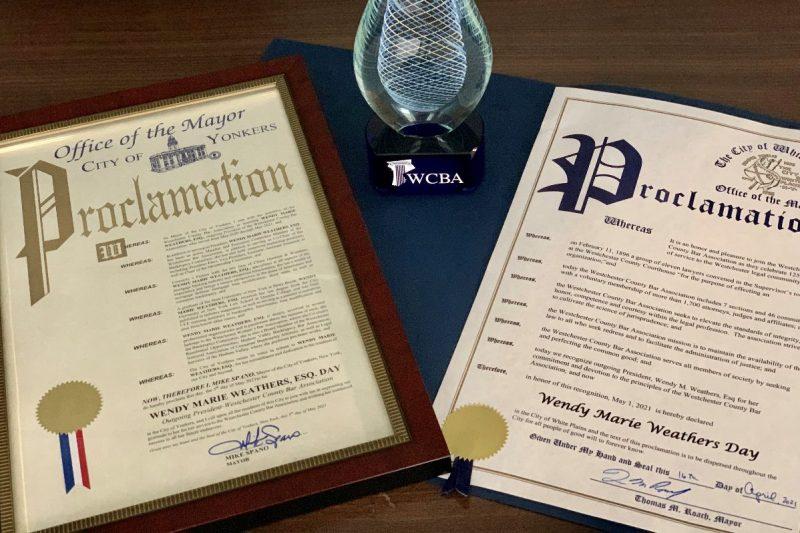
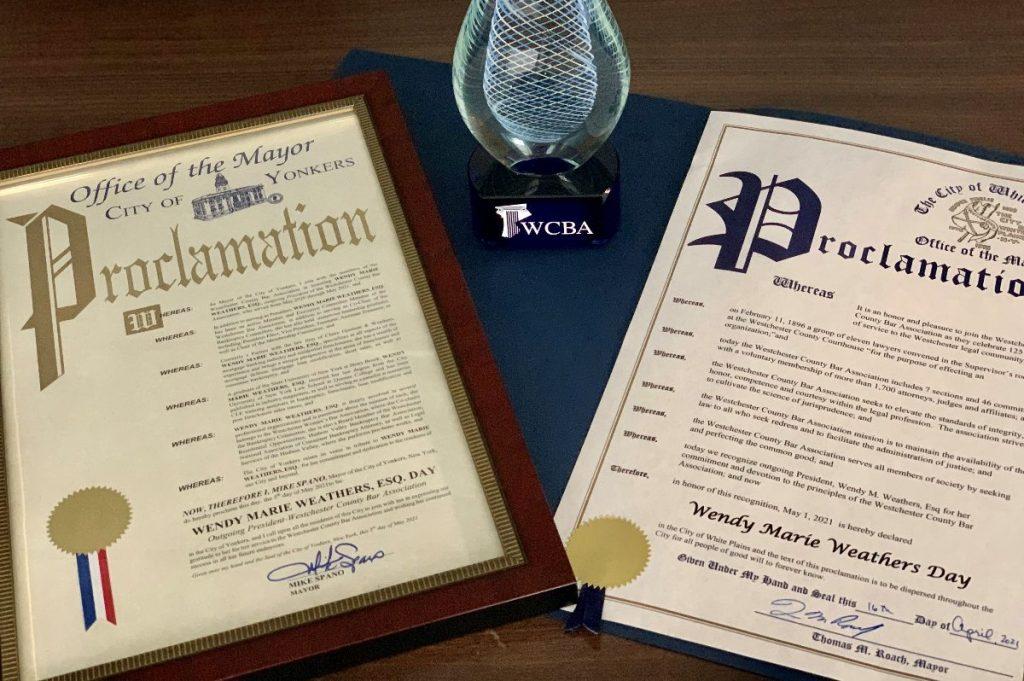
Our very own Wendy Marie Weathers is being honored by the Mayors of the City of White Plains and City of Yonkers for her accomplishments and tenure as the President of the Westchester County Bar Association. On May, 1, 2021, the City of White Plains and on May 5, 2021 the City of Yonkers have officially proclaimed each day to be known as “Wendy Marie Weathers’ Day”. We are so excited to be honoring her and her many accomplishments!
For more information on Wendy’s accomplishments during her presidential term, please read her farewell message in the Westchester magazine.

On March 9, 2021, Governor Cuomo signed the COVID-19 Emergency Protect Our Small Business Act of 2021 establishing eviction and foreclosure protections for small businesses who have suffered COVID related hardships, which expands on commercial eviction and foreclosure protections already in place. The Act also will help protect small businesses who are delinquent on taxes.
“New York has gone to extraordinary lengths to protect and strengthen our economy throughout the war on COVID, and it is critical that we continue to provide support as we ramp up our vaccination efforts across the state,” Governor Cuomo said. “By signing the COVID-19 Emergency Protect Our Small Business Act of 2021 we are strengthening the backbone of our economy – our small businesses that have faced unprecedented hardships – and this legislation will be instrumental in helping build New York’s economy back better than ever before.”
The new legislation will apply to small businesses with under 50 employees, as well as small businesses with 10 or less units. It will allow these small business tenants, as well as commercial mortgagors to declare to either a landlord or mortgagee that they have experienced a financial hardship and thus qualify for protections under this Act.
If you are a commercial tenant or facing a foreclosure on your small business due to delinquent mortgage payments or taxes, please call our office for more information, 914-472-6202. We are here to help you through this difficult time.